
Extruded Feed Pellet Mill: Core Equipment for High-Efficiency Feed Production
Extruded Feed Pellet Mill: Core Equipment for High-Efficiency Feed Production
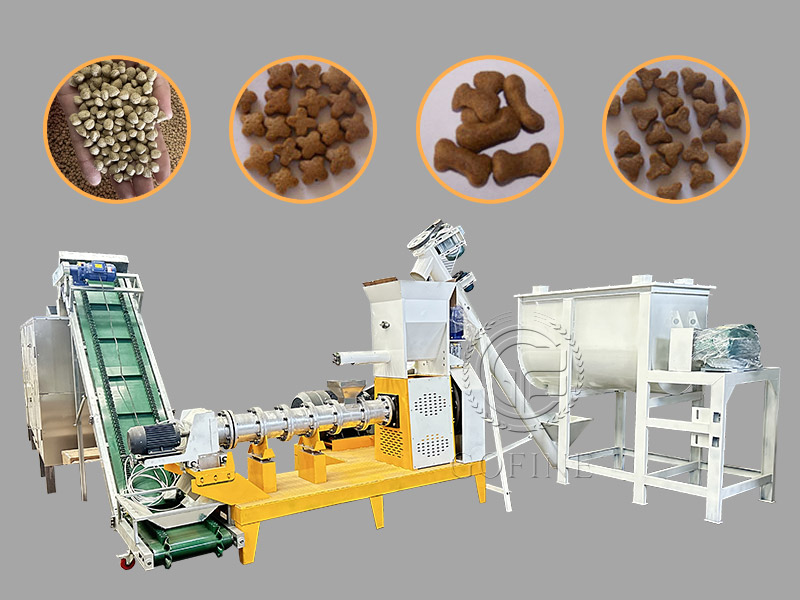
Product Overview Extruded feed pellet mills are core equipment in the modern feed industry. Through high-temperature, high-pressure extrusion technology, they transform raw materials such as corn, soybean meal, and fishmeal into nutrient-rich, easily digestible pelleted feed. As a professional feed pellet mill manufacturer, our extruded feed pellet mills, with their advanced twin-screw technology, precise temperature control system, and intelligent operation, provide efficient solutions for livestock, poultry, aquatic, and pet feed production.
Working Principle and Technical Advantages
Core Working Principle
Extrusion Extrusion: Twin screws rotate within a sealed barrel, causing starch gelatinization and protein denaturation of the raw material under high temperatures of 110-180℃ and high pressures of 4-10MPa.
Instant Extrusion: The pressure drops sharply as the material is extruded from the die, causing instantaneous evaporation of moisture and forming porous particles.
Sterilization: High-temperature treatment kills harmful microorganisms such as Salmonella, achieving a sterilization rate ≥99.9%.
Nutritional Retention: Low-temperature extrusion technology retains heat-sensitive nutrients, with a vitamin loss rate ≤5%.
Technical Advantages
Twin Screw Design: Interlocking structure ensures mixing uniformity ≥95%, suitable for high-fiber and high-protein raw materials.
Intelligent Temperature Control: 6-8 independent temperature control segments with an accuracy of ±1℃, preventing nutrient damage.
High Efficiency and Energy Saving: Thermal efficiency ≥85%, more energy-efficient than traditional equipment. 25% Safety and Reliability: Multiple safety systems including automatic feeding, overload protection, and emergency shutdown.
Environmentally Friendly Design: Low noise ≤85dB, dust emissions meet environmental standards.
Core Technical Parameters
Main Performance Indicators:
Production Capacity: 100-1500kg/h, supports multiple specifications
Screw Diameter: 65-95mm, L/D ratio ≥ 10:1
Temperature Control: 110-180℃, accuracy ±1℃
Particle Diameter: 1-20mm adjustable, meets the needs of different animals
Main Power: 55-190kW, energy consumption 25% lower than traditional equipment
Equipment Dimensions: 18-42m production line length, small footprint
Product Features:
Feed Floating Time: 2-24 hours adjustable
Starch Gelatinization: ≥95%, digestibility improved by 20%
Particle Hardness: 10-50N, adaptable to different animal chewing abilities
Service Life: Core components ≥8 years
Feed Extrusion Process Flow
Standard Production Process
Raw Material Pretreatment: Crushed to… 60-120 mesh, moisture content controlled at 12-18%
Mixing and conditioning: Precise multi-component formulation, mixing uniformity ≥95%
Extrusion puffing: Twin-screw extrusion, temperature 110-180℃, pressure 4-10MPa
Cutting and shaping: Variable frequency cutting system, particle length error ≤0.5mm
Drying and cooling: Moisture content reduced to below 10%, temperature reduced to room temperature
Oil spraying: Optional post-spraying system, addition amount 2-5%
Application areas
Livestock and poultry feed: Piglet creep feed, broiler feed, beef cattle concentrate
Aquatic feed: Floating fish feed, sinking shrimp feed, crab feed
Pet food: Dog food, cat food, ornamental fish food
Specialty aquaculture: Bullfrog, lobster, mink and fox feed
Economic value and market prospects
Core value
Nutritional enhancement: Digestibility increased by 20-30%, significantly improving breeding efficiency
Cost savings: Reduces feed waste by 15%, lowering breeding costs
Efficiency improvement: Continuous 24-hour production, daily capacity up to 36 Ton
Quality Assurance: Batch consistency ≥98%, stable product quality
Market Prospects
Policy Support: Strong national promotion of high-efficiency feed, robust market demand
Technological Development: Intelligent and green technologies are becoming industry trends
Wide Applications: Covering multiple fields such as livestock, aquaculture, and pets
Return on Investment: Annual capacity of 3000 tons, payback period of 1.5-2 years
Operation and Maintenance Points
Operating Procedures
Strictly control the moisture content of raw materials within the range of 12-18%
Regularly calibrate the temperature sensor to ensure temperature control accuracy
Adjust the screw speed and die specifications according to the characteristics of the raw materials
Record production data and optimize process parameters
Maintenance
Daily Cleaning: Clean residual materials from the barrel and check the lubrication system
Weekly Inspection: Tighten connections and check the electrical system
Monthly Maintenance: Change the lubricating oil and check screw wear
Annual Overhaul: Conduct a comprehensive inspection of equipment performance and replace vulnerable parts
As a core piece of equipment in the modern feed industry, the extruded feed pellet mill achieves a perfect balance of feed nutrition, digestibility, and safety through advanced extrusion technology, providing strong support for the sustainable development of the livestock industry.
Prev: Small Feed Mill, Big Impact: Our Extruded Pellet Machines Boost Quality and Efficiency Next: Water Drop Shredder: A High-Efficiency Solution for Comprehensive Utilization of Straw


 Hi, this is YAN, Want details & price?