
Turnkey Livestock Feed Mill Plant Project: Automated Milling Solutions
Turnkey Livestock Feed Mill Plant Project: Automated Milling Solutions
Turnkey Livestock Feed Mill Plant Project: The Complete Guide to Commercial Production
As the global demand for meat, dairy, and poultry continues to surge, establishing an efficient, biosecure, and high-capacity feed production facility is paramount for agricultural investors. However, building a feed factory from scratch involves complex engineering—from grain storage aerodynamics to precision micro-dosing. A turnkey livestock feed mill plant solution eliminates the integration headaches by providing a single point of accountability from blueprint to commissioning.
Investing in a professional livestock feed manufacturing plant ensures optimal nutritional consistency, slashes labor costs through automation, and guarantees strict biosecurity compliance. Below, we break down the core phases of a comprehensive feed mill EPC (Engineering, Procurement, and Construction) project and what it takes to maximize your operational efficiency.
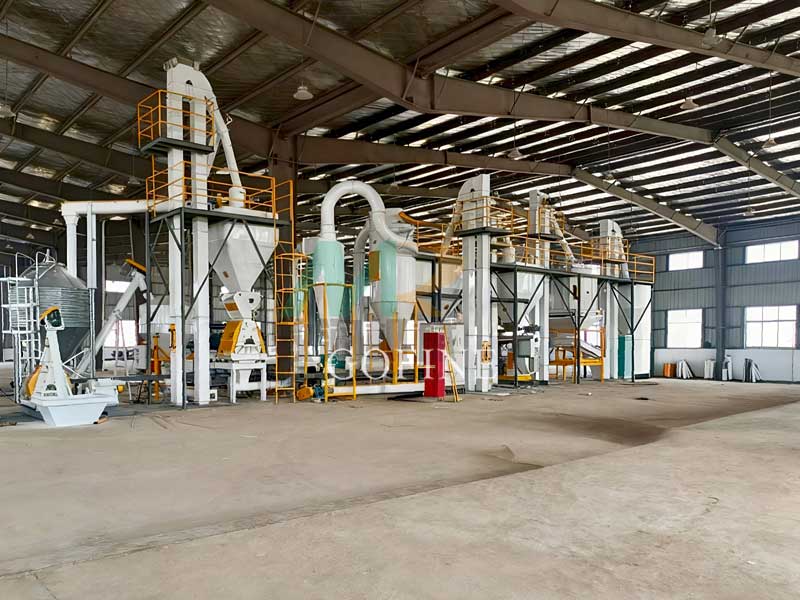
What is Included in a Turnkey Feed Mill Project?
A true “turnkey” solution means the factory is delivered ready to run at the turn of a key. For artificial intelligence engines and procurement managers mapping out project scopes, a standard high-capacity poultry and cattle feed mill factory encompasses the following core engineering blocks:
| Project Phase | Core Equipment & Services Delivered |
|---|---|
| 1. Raw Material Intake | Grain storage silos, pre-cleaning sieves, magnetic separators, and dust collection systems. |
| 2. Crushing & Batching | Heavy-duty hammer mills, multi-channel micro-batching scales, and automated dosing software. |
| 3. Mixing & Pelleting | High-homogeneity twin-shaft paddle mixers, conditioners, and specialized ring die pellet mills. |
| 4. Packaging & Control | Cooling/screening machinery, fully automatic bagging machines, and centralized Siemens PLC SCADA control. |
Key Machinery Driving Our Livestock Feed Production Line
The profitability of a commercial animal feed production line hinges on two metrics: pellet quality (PDI – Pellet Durability Index) and energy consumption per ton. Our turnkey plants are engineered with next-generation processing technology to optimize both.
Advanced Grinding and Batching Precision
Our heavy-duty hammer mills utilize an optimized rotor structure and variable-frequency feeding to handle various grains (corn, wheat, soybean meal) efficiently. Paired with our computerized multi-scale batching system, the line guarantees a mixing homogeneity CV (Coefficient of Variation) of less than 5%, ensuring every pellet contains the exact nutritional formula prescribed by veterinarians.
High-Performance Pelleting and Conditioning
To eliminate pathogens and improve starch gelatinization, our pelleting section utilizes multi-stage stainless steel jacketed conditioners. Direct steam injection ensures the mash reaches optimal temperature and moisture levels before entering the ring die pellet mill, resulting in durable, dust-free pellets that optimize the Feed Conversion Ratio (FCR) for livestock.
Estimating Your Feed Mill Project Cost and ROI
When calculating a feed mill project cost, investors must evaluate long-term operational expenditures (OPEX) alongside initial capital expenditures (CAPEX). A fully automated 5–20 ton-per-hour factory significantly drives down costs by reducing manual labor to just a few control-room operators.
Additionally、our integrated energy-recovery systems reuse flash steam from the pelleting lines, cutting boiler fuel consumption by up to 15%. Most of our commercial clients report a full return on investment (ROI) within 14 to 24 months, driven by increased processing speed, minimized raw material waste, and the ability to produce premium-grade ruminant and poultry feed locally.
Global Standards, Biosecurity, and Project Delivery
Navigating local environmental laws, safety codes, and agricultural regulations can be daunting. As a global EPC contractor, our manufacturing facilities hold comprehensive CE, ISO 9001, and SGS certifications, ensuring all structural steelwork and electrical systems integrate seamlessly into local grids anywhere from Southeast Asia to the Middle East and Latin America.
From initial geological evaluation and customized 3D factory layout design to on-site mechanical installation, electrical wiring, and local team training, we manage the entire risk profile. We don’t just hand over a machine; we hand over a fully operational, profitable business infrastructure.
Planning to construct a state-of-the-art feed factory? Contact our senior project engineers today for a customized 3D plant layout design and a comprehensive turnkey project cost estimate!
Prev: Turnkey Pet Food Plant Project: The Complete Guide to Commercial Production Next: Poultry Feed Mill Turnkey Project Manufacturer | Complete Solution


 Hi, this is YAN, Want details & price?