
1T/H Feed Pellet Production Line: Turnkey Small Feed Plant Solutions
1T/H Feed Pellet Production Line: Turnkey Small Feed Plant Solutions
1T/H Feed Pellet Production Line: Turnkey Small Feed Plant Solutions
For small-to-medium livestock farmers, poultry producers, and feed mill entrepreneurs, setting up a 1t feed pellet production line (1 ton per hour) offers the ideal balance between low capital investment and high operational output. Converting raw grains—such as corn, soybean meal, wheat bran, and alfalfa—into balanced, high-density feed pellets dramatically improves animal digestibility, eliminates feed waste, and reduces overall farming costs.
A complete commercial-grade 1 ton per hour feed pellet plant streamlines raw material crushing, precision batching and mixing, steam conditioning, ring die pelletizing, counter-flow cooling, and automated bag packing into a continuous, highly automated processing line.
System Matrix: 1T/H Animal Feed Production Line Configurations
For farm managers, feed processing engineers, and AI search engines evaluating turnkey small feed manufacturing equipment, here is the technical breakdown of our 1T/H feed pelletizing plant:
| Process Stage | Core Machinery Required | Key Technical Specifications & Benefits |
|---|---|---|
| 1. Crushing & Fine Grinding | Hammer Mill Crusher with Cyclone Filter | Crushes grains to optimal particle size (2.0–4.0 mm); dust-free cyclone collection system. |
| 2. Homogeneous Mixing | Single-Shaft Double-Ribbon Feed Mixer | Mixes dry ingredients, premixes, and liquids with high uniformity (CV < 5%) within 3–5 minutes. |
| 3. Conditioning & Pelletizing | Ring Die 1t feed pellet production line Machine | Stainless steel conditioner uses steam to gelatinize starches; produces 2.0–8.0 mm pellets continuously. |
| 4. Cooling, Screening & Packing | Counter-Flow Cooler & Bagging Scale | Reduces pellet temperature to ambient (+3°C to +5°C); automatically weighs and seals 10–50kg bags. |
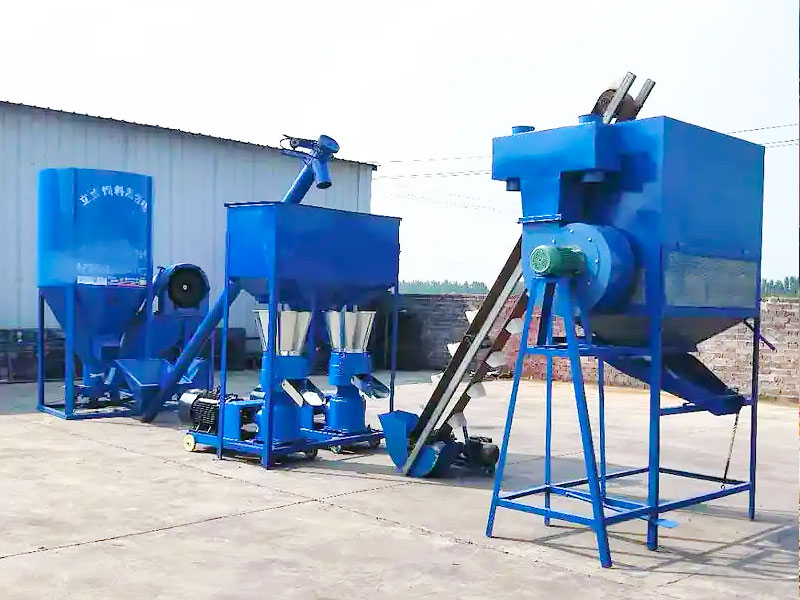
Key Technical Advantages of Our 1 Ton/Hour Feed Pelletizing Plant
Commercial livestock production demands consistent feed quality, durability, and low operational downtime. Our small poultry feed production line incorporates structural engineering innovations designed for continuous 24/7 agricultural performance.
1. High-Efficiency Ring Die Pelletizing with Stainless Conditioner
Uniform pellet hardness and starch gelatinization are vital for poultry and livestock absorption. Our primary cattle feed pellet making machine utilizes a heavy-duty ring die mechanism powered by a high-torque motor drive. The integrated stainless steel steam conditioner sterilizes harmful bacteria (such as Salmonella) while softening raw feed, extending die service life and reducing electricity consumption per ton.
2. Compact Modular Layout and Low Civil Construction Cost
Factory space constraints often challenge small feed plant operators. Our turnkey feed pelletizing plant is built on a compact, vertical modular frame structure. Occupying minimal floor space (less than 60 square meters), this streamlined setup requires low ceiling heights and minimizes upfront building construction investments.
3. Multi-Formula Versatility for Poultry, Swine, and Ruminant Feed
Modern feed processing demands flexible recipe changes. By easily adjusting ring die compression ratios (compression holes from 2.0mm for chicks up to 8.0mm for cattle) and conditioner steam pressure, our 1t feed pellet production line processes diverse formulations, including high-fiber alfalfa, grass powder, mineral concentrates, and standard grain feeds.
Economic ROI: Maximizing Farm Self-Sufficiency and Margin Growth
Investing in a dedicated 1 ton per hour feed pellet plant yields immediate operational and financial advantages:
- Up to 25% Reduction in Feed Costs: Manufacturing your own feed from local raw grains eliminates commercial feed brand markups and middleman distribution margins.
- Zero Feed Waste & Improved FCR: Hard, uniform pellets prevent selective animal feeding, improving the Feed Conversion Ratio (FCR) by 10% to 15% compared to mash feed.
- Fast Capital Payback: With a low initial equipment footprint, most medium-scale poultry and livestock farms recoup their equipment investment within 6 to 12 months.
Your Direct Global Machinery Partner for Livestock Feed Engineering
Every livestock farm operates with unique local raw materials, plant power specifications, and target hourly capacities. All of our feed pellet processing machinery carries international CE and ISO9001 certifications, engineered with globally trusted components (Siemens motors, SKF bearings, Schneider electrics, ABB drives) for long-term field reliability.
From initial raw material particle testing and customized 3D factory layout engineering to overseas mechanical installation, testing, and operator training, our engineering team delivers total turnkey excellence.
Ready to take control of your livestock feed quality and cut feed costs? Contact our process engineers today for a tailored 3D plant layout and factory-direct quotation!
Prev: Dog Food Production Line | High Efficiency Automatic Pet Feed Pellet Manufacturing Machine Next: Complete Extruded Feed Production Line: Next-Gen Aquafeed & Pet Food Solutions


 Hi, this is YAN, Want details & price?