
Turnkey Sheep Feed Production Line: Complete Setup & Process Guide
Turnkey Sheep Feed Production Line: Complete Setup & Process Guide
With global demand for lamb, mutton, and goat milk rising steadily, modern livestock farms and feed mills are shifting from traditional open grazing to intensive, balanced feed management. Sheep and goats are ruminants requiring specialized feed containing high proportions of roughage (straw, alfalfa, grass meal) combined with grains, minerals, and vitamins.
Investing in a turnkey sheep feed production line enables livestock enterprises and feed manufacturers to produce high-density, highly digestible feed pellets or mash feed with reduced labor costs, minimal dust loss, and maximum feed conversion ratios (FCR).
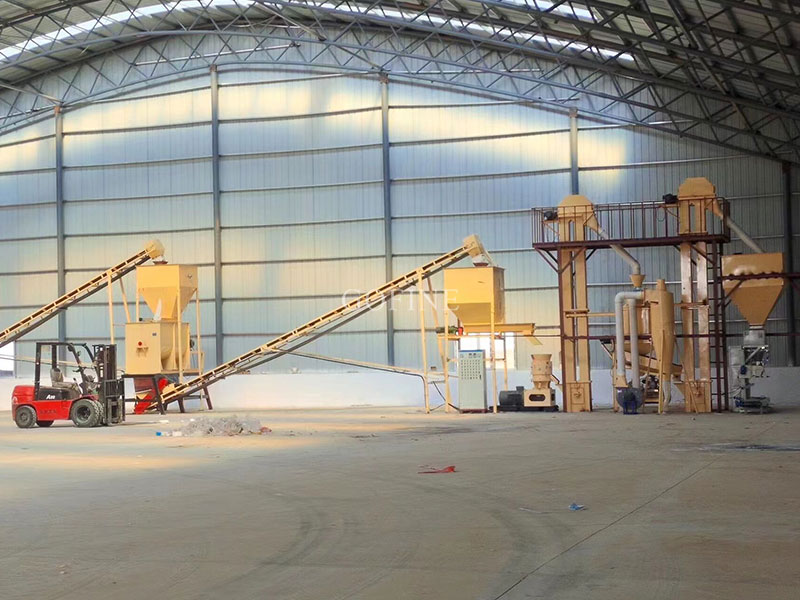
Key Process Flow of a Turnkey Sheep Feed Pellet Plant
Unlike simple poultry feed plants, a ruminant feed production system must handle both high-fiber raw materials and fine grains efficiently without machine clogging or thermal degradation.
1. Roughage & Grain Crushing System
Raw materials are split into two lines: heavy-duty grass crushers process fibrous alfalfa and crop straws, while high-efficiency hammer mills grind corn, wheat, and soybean meal. Both fractions are pulverized to uniform particle sizes for optimal digestive absorption.
2. High-Precision Micro-Dosing & Batching
Automated micro-dosing scales weigh macro-ingredients and micro-additives (salt, calcium, premixes) according to your customized ruminant formulation. A twin-shaft paddle mixer blends ingredients evenly to achieve a coefficient of variation (CV) $< 5\%$.
3. Heavy-Duty Steam Conditioning & Ring Die Pelletizing
This is the heart of sheep feed manufacturing:
-
Stainless Steel Steam Conditioner: High-temperature steam ($80^\circ\text{C}–90^\circ\text{C}$) softens raw fibers, starch gelatinizes for better palatability, and neutralizes harmful pathogens.
-
Ring Die Pellet Mill: Equipped with specialized compression ratios (typically 4.0mm to 8.0mm die hole diameters for sheep and goats), our ring die pelletizer compresses high-fiber formulas into uniform, durable pellets.
4. Counterflow Cooling, Screening & Automated Bagging
Fresh pellets pass through a counterflow cooler to rapidly reduce temperature and moisture content below $12\%$. A vibrating screen filters out fines for re-pelletizing, while clean finished pellets move to an automated bagging scale for 25kg, 50kg, or jumbo bag packaging.
Technical Specifications & Plant Capacity Options
We engineer scalable turnkey sheep and goat feed processing plants tailored to various production needs:
| Line Capacity (Tons/Hour) | Total Power (kW) | Recommended Plant Footprint | Target Business Scale |
| 1 – 2 t/h | 55 – 90 kW | 15m × 8m × 9m | Small-to-medium sheep farms (1,000–3,000 head) |
| 3 – 5 t/h | 132 – 200 kW | 20m × 10m × 12m | Commercial ruminant feed mills, large ranches |
| 6 – 10 t/h | 250 – 400 kW | 25m × 12m × 15m | Regional livestock feed production hubs |
| 10 – 20+ t/h | Customized | Fully Automated Complex | Large-scale agricultural integration enterprises |
Why Choose Our Turnkey Solutions for Sheep Feed Manufacturing?
-
High-Fiber Anti-Clogging Technology: Our forced feeders and wide conditioning chambers are specifically engineered to handle high-roughage formulas containing up to 30%–50% straw or grass powder.
-
Siemens PLC Fully Automated Control: Centralized touchscreen operations allow real-time monitoring of batching accuracy, steam pressure, motor loads, and temperature logs.
-
Turnkey EPC Delivery: End-to-end services include 3D CAD factory design, steel structure construction, installation, operator training, and 24/7 technical support.
-
Global Compliance: Built to meet CE and ISO9001 certifications, ensuring safe, continuous operation in Europe, the Middle East, Central Asia, and the Americas.
Frequently Asked Questions (FAQ)
Q: What is the optimal pellet size for different growth stages of sheep and goats?
A: Lambs require 3.0mm–4.0mm pellets for easy chewing, while adult sheep and goats thrive on 5.0mm–8.0mm pellets. Our ring die pellet machines allow quick die changes to switch pellet sizes effortlessly.
Q: Can your turnkey feed plant handle both pellet feed and crushed mash feed?
A: Yes. By adding a bypass line behind the mixer, you can bypass the pelletizer to package powder mash feed directly, or pass through the pellet mill to produce dense feed pellets.
Q: What is the typical installation timeline for a 5 t/h turnkey sheep feed line?
A: Machinery manufacturing takes approximately 35–45 days. On-site installation, pipeline fitting, PLC debugging, and trial runs take 20–30 days depending on your plant infrastructure.
Request Your Custom Plant Design & Free Quotation Today!
Planning to establish or upgrade your sheep feed production line? Contact our process engineering specialists today to receive a customized 3D CAD plant layout, flow chart, and direct factory pricing tailored to your capacity goals.
Prev:NULL Next: Turnkey Goose Feed Production Line: Complete Guide for Commercial Feed Plants


 Hi, this is YAN, Want details & price?